
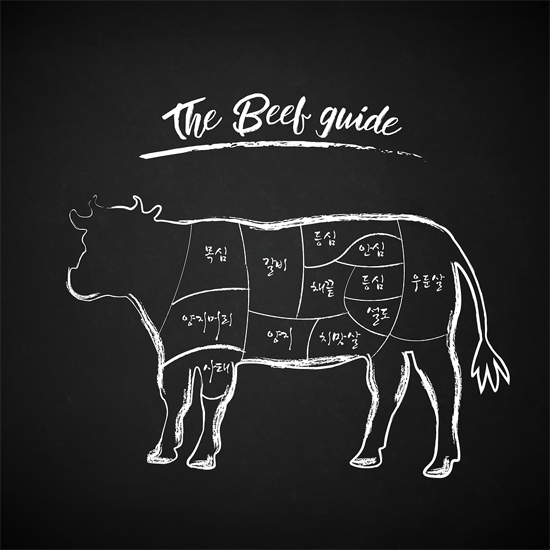
Sirloin is the cut of meat located on the outside of the rib cage, whereas tenderloin is on the inside. Sirloin is both longer and larger than tenderloin. A distinguishing external feature of this cut is the horizontal streaks of fat where the ribs were once attached, giving it a characteristic streaky appearance. When sliced thinly, a key feature is a crescent-shaped yellow ligament.
Sirloin’s Culinary Use in Korea and the West
In Korea, sirloin is commonly used for bulgogi. When it comes to quality, sirloin is considered very tender, and the surrounding fat enhances the overall flavor of the meat. Sirloin from a well-raised cow tends to have more fat accumulated between the muscle fibers. In the West, this is called marbled meat for its marble-like appearance and is sold at a high price.
In the West, sirloin is often sold with the rib bone still attached and cut to the thickness of the bone. The part of the sirloin closer to the neck is called the rib, while the part near the loin is called the loin. Large pieces cut with several ribs are roasted whole in an oven, and individual rib cuts are used for steak. In Korea, pork sirloin is used for jeyuk (spicy stir-fried pork). In the West, it’s also sold with the rib bone attached; single-rib cuts are for pork chops, and larger pieces with several ribs are for roasting.